
Are you 21 or older?
Cigar Smiths is for adults of legal smoking age. Please confirm you are 21 or older to enter.
A cigar keeps trading moisture with the air until you light it. Hold it at 65 to 70 percent humidity and around 68°F, and it smokes the way it was rolled.
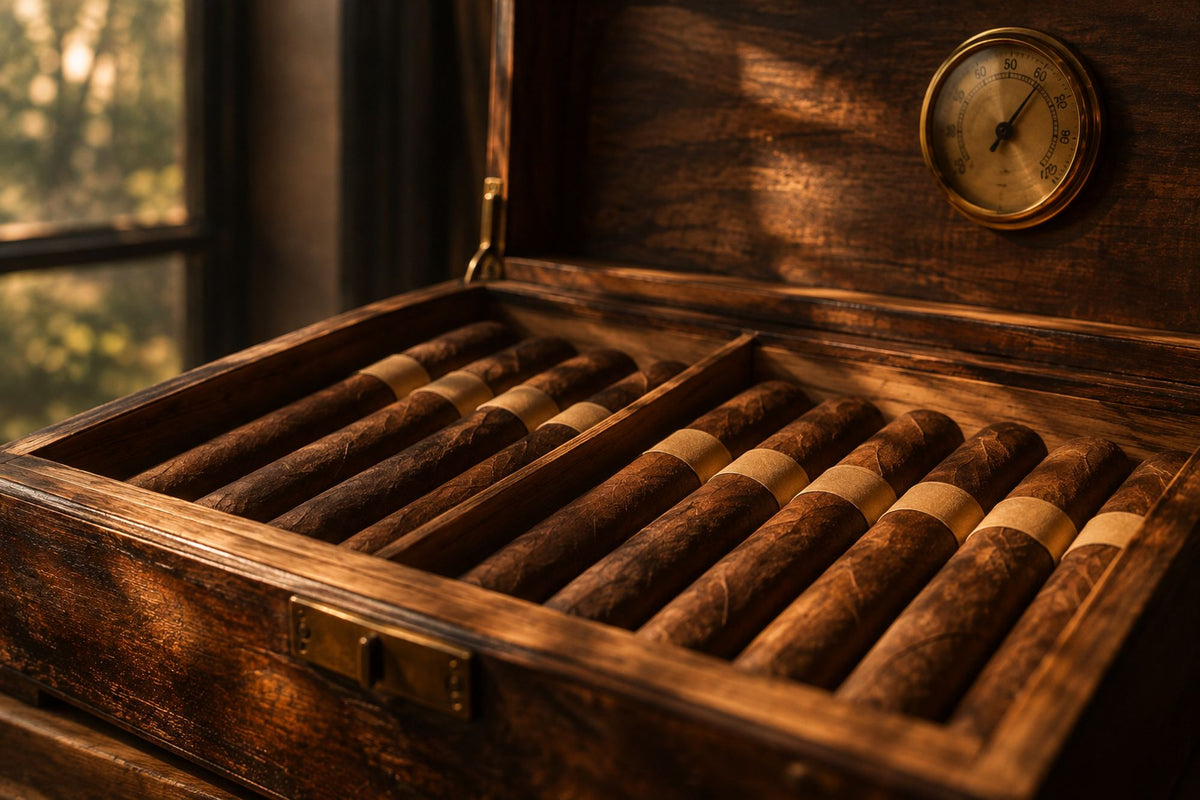
A cigar is fermented and aged tobacco, and it keeps trading moisture with the air until the day you light it. Too dry and it cracks and burns hot. Too wet and it draws tight and grows mold. Getting it right takes two numbers and a few minutes a month.
Humidity, 65 to 70 percent. The lower end suits full, oily blends; the higher end suits thin cigars and delicate wrappers.
Temperature, 65 to 70°F. Above about 75°F the eggs of the tobacco beetle can hatch, and a warm, humid box is exactly what they want.
Steady beats exact: 67 percent every day is better than a box that swings between 60 and 75.
A humidor is a box lined with Spanish cedar that holds moisture, releases it slowly and resists mold. A sealed food container with a humidity pack, a tupperdor, does the same job on a budget. Keep either in a dark room, away from windows, vents and outside walls, and never in the refrigerator: it is cold, dry and full of smells.
Wipe the cedar
Use a clean cloth barely damp with distilled water. Never soak the wood, never use tap water.
Close it with moisture inside
Add a humidity pack, or a small dish with a sponge and distilled water.
Wait for two steady days
Check the hygrometer daily. When it holds your number two days in a row, it is ready.
Make a damp salt paste
A capful of table salt and a few drops of water.
Seal it with the hygrometer
Both in a plastic bag, for 8 to 12 hours.
Read the difference
The bag settles at 75 percent. However far your reading is from 75 is how far off your hygrometer is.
Too dry: the wrapper looks dull and crackles when pressed. Bring it back slowly, a week at about 62 percent, then into the humidor.
Too wet: spongy, tight draw, hard to keep lit. Rest it a few days at a lower humidity.
Tiny holes: tobacco beetles. Freeze the cigars, sealed, for three days, thaw them a day in the refrigerator, and clean the humidor.
Between 65 and 70 percent relative humidity, at 65 to 70°F. Most smokers settle at 65 or 69 percent.
No. A refrigerator is too cold and too dry, and cigars absorb its smells. Use a humidor or a sealed container with a humidity pack.
If it is fine, dry and brushes off cleanly, it is plume, crystals from the tobacco oils, and it is harmless. If it is fuzzy, colored or smears, it is mold: throw that cigar away and clean the humidor.
Either works in a steady humidor. Leave it on for cigars you carry or keep a long time; take it off to let them settle in faster.
Store them right, and the cigar you light in six months will be the one you chose today, or better.
Keep reading

Strength is not color and it is not flavor. What makes a cigar mild or full, how to read our five-step meter and where to start.

The weekly digest
The best of the Journal, new arrivals and Inner Circle drops, in one email. For adults 21 and over.